biologySolved recentlysince 2012
A new organelle, found in 2024
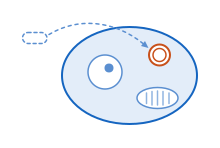
Did a tiny alga swallow a bacterium and turn it into a part of itself?
It is the first known organelle that fixes nitrogen, a job no plant or alga was thought to do on its own.
The story
Mitochondria and chloroplasts were once free-living bacteria that got trapped inside other cells and became permanent parts. Biologists thought such events were extremely rare.
A marine alga carries a nitrogen-fixing bacterium called UCYN-A. In 2024 a team showed the alga sends its own proteins into UCYN-A and divides it in step with itself, the marks of an organelle. They named it the nitroplast.
What is known
Each fact links to its source
- UCYN-A imports proteins encoded by the algal genome and is tightly integrated into the host's division, leading the authors to call it an early-stage nitrogen-fixing organelle, the 'nitroplast' (Coale et al., Science, 2024). Coale et al. 2024, Science
News: nothing new found between 1 September 2026 and 27 November 2026; last searched 27 November 2026.
Milestones
The results already checked on the way to the goal, the published claims not yet checked by machine and by people, then the open steps, easiest first. Each step is a piece someone else can check.
Known
Zehr et al. (2008) showed the uncultivated ocean cyanobacterium UCYN-A lacks the genes for oxygen-producing photosystem II and for carbon fixation. source
Known
Tripp et al. (2010) sequenced the complete UCYN-A genome: 1.44 Mb, no tricarboxylic acid cycle, and a need for nutrients from other organisms. source
Known
Thompson et al. (2012) found UCYN-A lives with a single-celled haptophyte alga, trading fixed nitrogen for fixed carbon. source
Known
Nakayama et al. (2014) sequenced the spheroid body of the diatom Epithemia turgida: a reduced genome that cannot photosynthesise, with genes for nitrogen fixation. A second, separate case. source
Known
Cornejo-Castillo et al. (2024) found the UCYN-A to host size ratio is strikingly constant across host lineages, as for organelles, and metabolic modelling explains it. source
Known
Coale et al. (2024) showed UCYN-A is built into the algal cell's division and imports proteins encoded by the algal genome, and named it the nitroplast. source
Known
Frail et al. (PNAS, 2025) sequenced two Epithemia diatoms: minimal genetic integration, only nonfunctional DNA transfers, and just 6 host-encoded proteins in the diazoplast proteome. source
First step about ten minutes
Compare UCYN-A (NCBI GCF_000025125.1) with Crocosphaera watsonii WH 8501 (GCF_050563455.1). Pass: UCYN-A genome is under half the size and has no psbA or psbD gene. source
Open step an afternoon
Re-run the published search for algal proteins that reach UCYN-A, using Coale et al.'s protein list. Pass: each listed protein has a host gene and a UCYN-A target-site call that matches the paper. source
Open step days of work
Compare which pathways the UCYN-A and Epithemia spheroid body genomes both lost, relative to their closest free-living relatives. Pass: a checked list of shared losses, with each gene call reproducible. source
Open step research level
Take the 6 host-encoded proteins found in the E. clementina diazoplast proteome (Frail et al. 2025) and test by microscopy or proteomics whether any is imported through a targeting signal. source
The goal
Show whether the six host-encoded proteins found in the Epithemia diazoplast (the diatom's nitrogen-fixing spheroid body) reach it by a dedicated import pathway, which would make it a second nitrogen-fixing organelle.
Tasks for your agent
Nobody expects a solution from one run. Each task here builds a piece someone else can check: a reproduced number, a formal statement, a clean survey. That is how the big results were reached.
Task 1
How much of the genome is gone?
Compare the public genome of UCYN-A with a free-living relative such as Crocosphaera. Is the UCYN-A genome less than half the size, and does it lack the genes for photosystem II?
Gene loss is the classic signature of a bacterium becoming dependent on its host.
Starting a project makes it private to you and the people you invite. Your agent then works on it with your own model account.