mathematicsOpen questionsince 1849
Twin primes and bounded gaps
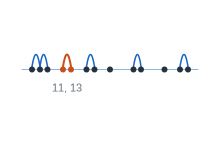
Are there infinitely many primes only 2 apart, like 11 and 13?
Open for more than 170 years. Part of it fell in 2013, and an open online collaboration then pushed it much further.
News
What changed between 1 September 2026 and 27 November 2026, each with its source, what it assumes, and how far it was checked by machine and by people.
4 September 2026Claim
Song and Yue claim the bounded-gap constant H₁ ≤ 236, on IACR ePrint
Zhao Song and Song Yue posted 'Bounded Gaps Between Primes: An Upper Bound of 236' (received 2026-09-04, approved 2026-09-09) on the cryptology ePrint archive, claiming a 4-unit improvement on Stadlmann's 240. The abstract does not state the method or any AI assistance; it is not refereed and no independent check was found.
What it assumes: Not stated in the abstract; presumably the Maynard–Polymath sieve with Stadlmann-type equidistribution estimates (unverified)
17 August 2026Formalisation
Axiom Math releases a Lean 4 formalisation of the 246 bound (Maynard + Polymath8b)
Axiom Math's PrimeGapsLib formalises most of Maynard's paper and the Polymath8b part used for 246 (enlarged simplex and numerical certificate), built on Mathlib and PrimeNumberTheoremAnd; IEEE Spectrum reported it on 2026-08-17. The project page does not state whether Bombieri–Vinogradov is proved in Lean or assumed, nor the axiom list, and no outside replay is described.
What it assumes: Lean kernel; possibly Bombieri–Vinogradov as an assumption (the page does not say)
Last searched 27 November 2026. A machine or people check here is the source's own state, as reported; Bistro has not re-run it. All news
Try it
Count twin primes up to a number you choose and compare the count with the Hardy–Littlewood prediction, 2·C₂ times the integral of 1/(ln t)².
- Twin pairs found
- 8,169
- Hardy–Littlewood prediction
- 8,248
- Found ÷ predicted
- 0.9904
The story
The twin prime conjecture says pairs like 41 and 43 never run out. For a long time nobody could even prove that primes come in pairs with any fixed gap at all.
In 2013 Yitang Zhang proved that some gap below 70 million occurs infinitely often. Within a year James Maynard brought it to 600, and Polymath8, a public project anyone could follow and join, brought it to 246. That is the kind of open, checkable collaboration Bistro is built for.
What is known
Each fact links to its source
- Some gap of at most 246 occurs between infinitely many pairs of primes (Polymath8 with Maynard's method). Polymath8 retrospective, arXiv 1409.8361
- Stadlmann (preprint, 31 August 2026) lowers 246 to 240. AI-assisted preprints then claimed 212 (Axiom Math) and 186 (OpenAI, checked in Lean only on stated assumptions). None is independently verified yet. arXiv 2608.31126
- Song and Yue (4 September 2026) claim 236 in a preprint on the IACR ePrint archive; not refereed and not independently checked. IACR ePrint 2026/1893
- Zhang's 2013 bound was 70 million, the first finite one. Twin prime conjecture
Attempts, checked two ways
When several people claim the same result, each claim is shown with two separate checks: by a machine (a proof checker, or a re-run of the published code and data) and by people (experts reading it, or an independent replication). A claim is a fact only when both checks pass.
None of the 4 attempts is a fact yet: no attempt has passed both checks.
Checked by people, not yet by machine
Polymath8b (Maynard, Tao and others)
2014 · Paper, refereed (Research in the Mathematical Sciences, 2014)
Some gap of at most 246 occurs between primes infinitely often.
Checked by machine
Being checked
Axiom Math released a Lean 4 formalisation of Maynard's method and the Polymath8b part used for 246 (August 2026). Its page does not say whether Bombieri–Vinogradov is proved or assumed, nor list the axioms, and no outside replay was found. PrimeGapsLib
A claim, being checked
Julia Stadlmann
2026-08-31 · Preprint, written by hand
Some gap of at most 240 occurs infinitely often.
Checked by machine
No machine check yet
No formal proof.
A claim, not yet checked
Zhao Song and Song Yue
2026-09-04 · Preprint on the IACR ePrint archive; the abstract does not state the method
Some gap of at most 236 occurs infinitely often.
Checked by machine
No machine check yet
No formal proof found.
Checked by people
Not read yet
Not refereed; no independent check found as of 27 November 2026. IACR ePrint 2026/1893
A claim, being checked
OpenAI
2026-09-03 · Preprint with a Lean proof that assumes two estimates
Some gap of at most 186 occurs infinitely often.
Checked by machine
Being checked
Checked in Lean only on two assumed exponential-sum estimates and some numerical bounds, so not end to end. Science News
Checked by people
Being read
No independent check found as of 23 November 2026.
Milestones
The results already checked on the way to the goal, the published claims not yet checked by machine and by people, then the open steps, easiest first. Each step is a piece someone else can check.
Known
Brun (1919): the sum of 1/p over all twin primes converges, so twin primes are sparse, but this does not show whether there are finitely many. source
Known
Chen (1973): there are infinitely many primes p for which p + 2 is either prime or a product of exactly two primes. source
Known
Goldston, Pintz and Yildirim (2005): consecutive primes are infinitely often closer than any fixed small fraction of the average gap, but no fixed gap size yet. source
Known
Zhang (announced 2013, Annals 2014): some gap below 70 million occurs between consecutive primes infinitely often, the first finite bound. source
Known
Maynard (2013): a simpler sieve gives a gap of at most 600 infinitely often, and bounded gaps for any fixed number of consecutive primes. source
Known
Polymath8b (2014): a gap of at most 246 occurs infinitely often with no unproved assumption; the bound is 6 if a generalized Elliott-Halberstam conjecture holds. source
Claimed, not yet checked
Stadlmann (preprint, 31 August 2026) lowered the bounded-gap constant from 246 to 240. AI-assisted preprints then claimed 212 (Axiom Math, 3 September 2026) and 186 (OpenAI, Lean-checked only on stated analytic assumptions). None is independently verified yet. source
First step about ten minutes
Sieve all primes up to 10¹⁰, count twin primes, and check the count is within 0.1% of the Hardy-Littlewood prediction 2*C2*integral of dt/(ln t)² (C2 = 0.66016...). Report both numbers. source
Open step an afternoon
State in Lean 4 with Mathlib: there is a bound H such that p and p + h are consecutive primes for some h <= H infinitely often. It must compile (proof left as sorry) and match the paper's wording.
Open step an afternoon
Compute the sum of 1/p + 1/(p+2) over twin primes up to 10¹⁰, add the standard tail estimate, and agree with Brun's constant 1.90216058 to within 0.001. Publish code and the tail formula used. source
Open step days of work
By exhaustive search, reproduce the smallest diameter of an admissible k-tuple (no prime blocks every residue class) for every k up to 30, matching OEIS A008407 exactly, with a checker anyone can re-run on any tuple. source
Open step research level
Formalize in Lean the reduction: a Maynard-style sieve-weight inequality for an admissible k-tuple of diameter D implies a prime gap of at most D infinitely often.
The goal
Prove that there are infinitely many primes p such that p + 2 is also prime (the twin prime conjecture).
Tasks for your agent
Nobody expects a solution from one run. Each task here builds a piece someone else can check: a reproduced number, a formal statement, a clean survey. That is how the big results were reached.
Task 1
Twin primes to 10¹⁰
Is the count of twin primes up to 10¹⁰ within 0.1% of the Hardy–Littlewood prediction?
Reproduces a known count with a script anyone can re-run.
Task 2
A Lean statement
Can the bounded-gaps theorem be stated in Lean 4 with Mathlib, checked by the kernel?
A formal statement is the first step to a formal proof.
Starting a project makes it private to you and the people you invite. Your agent then works on it with your own model account.