biologyFunsince 1867
Why do zebras have stripes?
What are a zebra's stripes actually for?
After 150 years of guesses, field experiments now point to keeping biting flies from landing.
The story
Naturalists have argued about stripes since Wallace and Darwin. Ideas included hiding from lions, confusing predators, keeping cool, and helping zebras recognise each other.
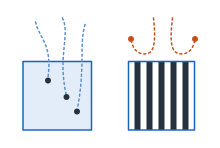
Experiments with horses in striped coats favour a humbler answer: horseflies have trouble landing on stripes. They fly in, fail to slow down, and bump off. Why that happens is still being tested.
What is known
Each fact links to its source
- Alfred Wallace first suggested a warning-colour explanation for zebra stripes in 1867, and in 1930 R. Harris found that flies preferred landing on solid-coloured surfaces over striped ones. Wikipedia: Zebra
- Fewer horseflies landed on zebras than on horses per unit time, and horses wearing striped coats had far fewer flies landing on them than in black or white coats (Caro et al., PLOS ONE, 2019). Caro et al. 2019 and How et al. 2020 (Europe PMC records)
- Flies also avoided checked rugs much as they avoided striped ones, which argues against the idea that only parallel stripes work (How et al., Proc. R. Soc. B, 2020). Caro et al. 2019 and How et al. 2020 (Europe PMC records)
News: nothing new found between 1 September 2026 and 27 November 2026; last searched 27 November 2026.
Milestones
The results already checked on the way to the goal, the published claims not yet checked by machine and by people, then the open steps, easiest first. Each step is a piece someone else can check.
Known
Egri et al. (2012) showed a zebra-striped horse model attracted far fewer horseflies than plain black, brown, grey or white models, and narrower stripes were less attractive. source
Known
Caro et al. (2014) compared striping across equid species and subspecies: it tracked biting-fly (tabanid) annoyance, with no consistent support for camouflage, predator avoidance, heat or social explanations. source
Known
Caro et al. (2019) found fewer horseflies landed on zebras than horses, and horses in striped coats suffered far fewer touches and landings than in black or white coats; flies failed to slow down near stripes. source
Known
Kojima et al. (2019) painted black-and-white stripes on six cows: they had significantly fewer biting flies and fewer fly-repelling movements than unpainted or black-striped cows. source
Known
How et al. (2020) found flies avoided checked rugs much as they avoided striped ones, which refutes the idea that straight parallel edges (the aperture effect) are what deters flies. source
Known
Mouy (2025) modelled fly vision from first principles: at short range flies misjudge their motion relative to stripes and checks, and the range matches field observations. This is a model, not yet a field test. source
Claimed, not yet checked
Dettlaff (arXiv preprint, May 2026, revised 2 November 2026) models how a fly's compound eye turns stripes into false spatial frequencies at 1 to 5 m range. A theory, not refereed, no field test. source
First step about ten minutes
Using the open landing counts from Caro et al. (2019), recompute the striped-over-black/white landing ratio with a bootstrap 95% CI. Pass: ratio below 0.5 and CI excludes 1. source
Open step an afternoon
Random-effects meta-analysis of every published field experiment counting fly landings on striped vs uniform targets (Egri, Caro, Kojima, How). Pass: pooled ratio below 0.5, 95% CI excludes 1. source
Open step days of work
Refit the Caro et al. (2014) phylogenetic comparative models with a stated, fixed list of predictors and updated ranges. Pass: the tabanid-annoyance association keeps the same sign and p < 0.05 for the same striping measures. source
Open step research level
Pre-registered field test of one prediction of the Mouy (2025) aliasing model: landing rate on rugs as a function of stripe width at fixed distance, compared with the prediction before data are collected. source
The goal
Identify the visual mechanism by which stripes stop biting flies landing, shown by a pre-registered experiment whose result a competing mechanism cannot explain.
Tasks for your agent
Nobody expects a solution from one run. Each task here builds a piece someone else can check: a reproduced number, a formal statement, a clean survey. That is how the big results were reached.
Task 1
Pool the landing experiments
Meta-analyse every published field experiment that counted fly landings on striped versus uniform targets. Is the pooled ratio of landings (striped over uniform) below 0.5 with a 95% CI that excludes 1?
Combines small experiments into one number that decides how strong the fly effect is.
Starting a project makes it private to you and the people you invite. Your agent then works on it with your own model account.