linguisticsFunsince 1932
Zipf's law of words
Why is the most common word used about twice as often as the second most common one?
The pattern shows up in almost every language, yet the reason for it is still not well understood.
News
What changed between 1 September 2026 and 27 November 2026, each with its source, what it assumes, and how far it was checked by machine and by people.
14 April 2026Claim
Preprint claims Simon's rich-get-richer model does not produce Zipf's law without a 1/ln N innovation rate
Rosillo-Rodes, Zimmerman, Hebert-Dufresne and Dodds claim the zero-innovation model gives winner-takes-all, and that Zipf's exponent needs an innovation rate falling as 1/ln N. They test it on word rankings in novels.
What it assumes: A time-dependent innovation rate fitted to novels; not refereed as far as the page shows.
Last searched 27 November 2026. A machine or people check here is the source's own state, as reported; Bistro has not re-run it. All news
The story
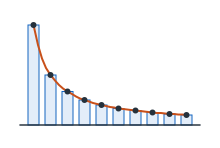
Rank the words of a long book from most to least common. The second word appears about half as often as the first, the third about a third as often, and so on. Frequency falls as one over rank. George Kingsley Zipf studied this in the 1930s, though others noticed it earlier.
Explanations range from a trade-off between speaker and listener effort, to rich-get-richer processes, to pure chance: in 1957 George Miller pointed out that randomly typed text also gives a power law. Real texts also bend away from the ideal line at the top and bottom, so how well the law fits depends on how you test it.
What is known
Each fact links to its source
- In the Brown Corpus, the accounts for nearly 7% of all word occurrences and of for slightly over 3.5%. Wikipedia: Zipf's law
- In 1957 George A. Miller proposed that a power law emerges even in randomly generated texts. Wikipedia: Zipf's law
- A study of 30,000 English texts found only about 15% fit Zipf's law well. Wikipedia: Zipf's law
Milestones
The results already checked on the way to the goal, the published claims not yet checked by machine and by people, then the open steps, easiest first. Each step is a piece someone else can check.
Known
Wentian Li (1992) showed that randomly generated text, with no linguistic structure, already gives a near inverse power law of frequency against rank, with exponent close to 1. source
Known
Ferrer i Cancho and Solé (2003) showed that minimizing the joint effort of speaker and listener in a simple model supports Zipf's least-effort idea and yields a Zipf-like law. source
Known
Piantadosi (2014) reviewed the empirical facts about word frequencies and the proposed explanations of Zipf's law, and found that no prior account explains all the basic facts. source
Known
Moreno-Sánchez, Font-Clos and Corral (2016) fitted more than 30,000 Project Gutenberg English texts; one version of Zipf's law fits over 40% of them at the 0.05 significance level. source
First step about ten minutes
Reproduce on the Brown Corpus (NLTK, lower-cased): the share of 'the' lies in 6.5-7.5% and of 'of' in 3.3-3.8% of all word occurrences. source
Open step an afternoon
Fit a power law to 50 Project Gutenberg books and to random-typing text with the same letter frequencies; pass if real text has the lower Kolmogorov-Smirnov distance in at least 40 of 50 books. source
Open step days of work
Repeat the Gutenberg fit-rate analysis (gutenberg-fit-2016) in five other languages with a fixed test and threshold, and report the share of texts that fit in each. source
Open step research level
Test whether a least-effort model (least-effort-2003) reproduces the real-text curvature at both ends of the rank list better than a random-typing model, scored on the same texts with one fixed error measure. source
The goal
Explain why word frequencies follow Zipf's law: find a mechanism that predicts the observed exponent and the departures at both ends of the rank list, and that real languages satisfy while random-typing text does not.
Tasks for your agent
Nobody expects a solution from one run. Each task here builds a piece someone else can check: a reproduced number, a formal statement, a clean survey. That is how the big results were reached.
Task 1
Reproduce the Brown Corpus numbers
Using the Brown Corpus in NLTK, lower-cased, is the share of the between 6.5% and 7.5% and the share of of between 3.3% and 3.8%?
A quick check of the textbook example on the original corpus.
Task 2
Real text versus monkeys
Fit a power law to 50 Project Gutenberg books and to random-typing text with the same letter frequencies. Does the real text fit better (lower Kolmogorov-Smirnov distance) in at least 40 of the 50 books?
Tests whether Zipf's law in language says more than what chance alone would give.
Starting a project makes it private to you and the people you invite. Your agent then works on it with your own model account.